
Creativity as Healing: Why Making Things Changes Us
Discover why creativity can be healing and how making art, writing, music, and other creative work helps us process emotion, reconnect with ourselves, and change from the inside out.
CREATIVITY & INSPIRATION
Bobby Owenby
6 min read
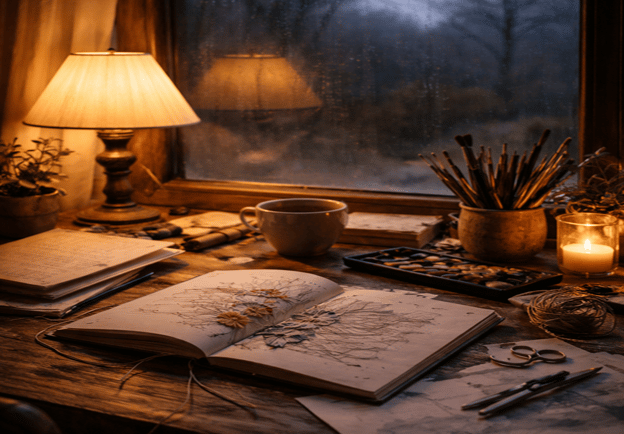
There are times when creativity feels like ambition.
You want to make something beautiful. You want to finish a project, build a body of work, grow your skills, or finally bring an idea to life. In those seasons, creativity can feel exciting, bold, and full of momentum.
But there is another side to creativity that matters just as much.
Sometimes creativity is not about achievement at all. Sometimes it is about survival. Sometimes it is about making sense of what you feel, giving shape to what hurts, or finding your way back to yourself after life has taken something out of you.
That is why creativity can feel so healing.
Not because every painting, poem, song, photograph, journal entry, collage, sketch, or story solves our problems. Not because making things erases pain. But because creativity gives us a way to move emotion, memory, confusion, grief, hope, and longing through our hands instead of letting it sit untouched inside us.
That process changes us.
Creativity gives the invisible a form
A lot of what people carry cannot be easily explained.
Some feelings are too layered for ordinary conversation. Some experiences live in the body before they ever become language. Some griefs feel shapeless. Some memories arrive as fragments. Some fears do not have neat names.
Creativity helps because it gives form to what feels formless.
A page can hold what your voice cannot say yet.
A painting can hold a mood you do not know how to describe.
A melody can carry ache.
A photograph can capture loneliness, tenderness, distance, or wonder without a single spoken word.
When you make something, even something small, you begin translating inner experience into visible form. That alone can be powerful. It tells your mind and body: this is real, this exists, this can be witnessed.
That is one reason healing through creative expression can feel so profound. You are no longer only carrying the feeling. You are relating to it.
Making things restores agency
Pain often makes people feel powerless.
Whether the heaviness comes from grief, stress, trauma, burnout, heartbreak, anxiety, or simply the pressure of being alive in difficult times, it can leave you feeling passive inside your own life. Things are happening to you. Your energy drops. Your thoughts spiral. Your emotions feel bigger than your ability to shape them.
Creativity interrupts that helplessness.
When you make something, you choose.
You choose a word.
A color.
A line.
A rhythm.
A texture.
A direction.
A voice.
Even if the act is small, it reminds you that you are not only a person being affected. You are also a person capable of shaping, expressing, and transforming experience.
That matters.
Healing is not always about feeling instantly better. Sometimes it is about slowly rebuilding your sense that you still have a voice, still have movement, still have a self that can act in the world.
Creativity helps restore that.
Art lets us process emotion indirectly
Not everyone can speak directly about what hurts. Even when we want to, direct language can feel too sharp, too exposing, or too incomplete.
Creativity offers another path.
You can write fiction that carries emotional truth without naming the source.
You can paint atmosphere instead of explanation.
You can create a character who holds your fear.
You can design something strange, tender, dark, or luminous that expresses what your ordinary words keep missing.
This indirectness is not avoidance. Often, it is access.
Sometimes the safest way to approach a difficult feeling is sideways. Art allows that. It gives emotion room to breathe without forcing it into a rigid explanation before it is ready.
That is one reason art as healing has endured across so many forms and cultures. It meets people where they are.
Creativity reconnects us with the self beneath performance
A great deal of modern life is performance.
We perform competence.
We perform productivity.
We perform normalcy.
We perform being fine.
Over time, that can create distance between who we seem to be and what we actually feel.
Creativity can close that distance.
When you make something honestly, even privately, you begin hearing yourself again. Your preferences return. Your symbols return. Your strange ideas return. Your inner voice becomes easier to recognize. You remember what draws you, what disturbs you, what softens you, what fascinates you, what you want to say, and what kind of beauty feels true to you.
This is part of why making things changes us. Creativity does not only produce objects. It reveals identity.
It shows us pieces of ourselves we may have ignored while trying to be efficient, useful, or acceptable.
The process matters as much as the result
People often talk about creativity as if the finished piece is the only thing that matters.
But much of the healing lives in the process.
It lives in the repetition of brushstrokes.
In the pause before the next sentence.
In the gathering of images.
In the cutting, arranging, stitching, layering, shaping, rewriting, listening, noticing, and trying again.
Creative work can become a space where the nervous system slows down enough to feel something manageable. It becomes a rhythm. A container. A way of staying with yourself.
The result may matter later. But the process is often where the real internal shift begins.
Making things creates meaning from experience
Human beings are meaning-making creatures.
We want to know what something meant. We want to understand what changed us, what broke us, what saved us, what remains. When painful or confusing experiences go unnamed and unshaped, they can feel chaotic. Creativity helps gather pieces into something more coherent.
This does not mean every creative act needs a grand message. It means that making things helps us move from raw experience to meaningful expression.
A poem can become a record.
A journal entry can become a turning point.
A sculpture can become a release.
A story can become a reframing.
A handmade object can become proof that beauty still exists after difficulty.
That is not a small thing. Meaning helps people endure.
Creativity invites transformation, not just expression
Creative healing is not only about “getting feelings out.” It is also about what happens after expression.
When you return to a draft and shape it, something changes.
When you turn pain into image, something changes.
When you take a memory and choose how to frame it, something changes.
You are no longer only experiencing life. You are engaging with it. Rearranging it. Responding to it.
That response creates transformation.
You may begin with grief and end with clarity.
You may begin with confusion and end with a symbol.
You may begin with anger and end with a voice that feels stronger than silence.
You may begin by trying to document what happened and end by discovering what it meant to you.
Creativity does not always heal by soothing. Sometimes it heals by revealing.
You do not have to be “good” at it for it to matter
This is one of the most important truths about healing through creative expression.
You do not need to be professionally trained.
You do not need to be impressive.
You do not need to be original on command.
You do not need to produce work worthy of applause.
The healing power of creativity does not depend on public success.
A private notebook can change you.
A rough sketch can change you.
A collage no one else sees can change you.
A voice memo recorded in the dark can change you.
The value is not always in polish. Sometimes it is in honesty.
Creativity helps us imagine life beyond the current moment
Pain narrows vision. Heavy seasons can make the future feel small, blank, or unreachable.
Creativity pushes back against that narrowing.
To make something is to imagine beyond the immediate moment. Even a tiny act of creation says there is still room for possibility. There is still room for beauty, play, curiosity, meaning, surprise, and becoming.
That is deeply healing.
A person who creates is, in some way, still reaching toward life.
Why making things changes us
Making things changes us because creativity is not separate from being human. It is one of the ways we metabolize experience.
We make to understand.
We make to remember.
We make to release.
We make to survive.
We make to witness.
We make to become.
The finished piece may hang on a wall, live in a journal, sit in a drawer, exist on a screen, or disappear entirely. But the act itself leaves a mark. It can soften what was hardened. Clarify what was tangled. Reveal what was hidden. Return us to ourselves when we have drifted.
That is the quiet power of creativity as healing.
It does not always arrive dramatically.
Sometimes it arrives as one page.
One sketch.
One note.
One handmade thing.
One moment of truth shaped into form.
And sometimes that is enough to begin changing us from the inside out.