
What Ghost Stories Can Teach Us About Great Storytelling
Discover what ghost stories can teach writers about great storytelling, including atmosphere, tension, memory, mystery, emotional truth, and why the unseen is often more powerful than explanation.
STORYTELLING & WRITING
Bobby Owenby
6 min read
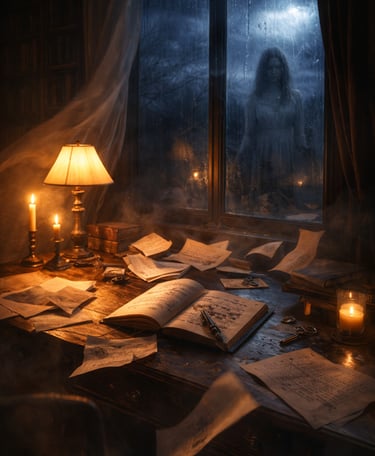
Some of the best lessons about storytelling do not come from writing manuals.
They come from ghost stories.
Not just because ghost stories are creepy. Not just because they deal in shadows, whispers, old houses, and things glimpsed at the edge of a dark hallway. But because, at their best, ghost stories understand something essential about how stories work: what people do not fully understand is often what grips them most.
A good ghost story is rarely only about a ghost. It is usually about memory, grief, guilt, place, fear, secrecy, or something unresolved that refuses to stay buried. That is exactly why ghost stories have survived for so long across cultures, families, and generations. They do more than scare us. They pull us forward. They make us lean in. They make us feel that something matters, even before we know exactly what it is.
And that is the heart of great storytelling.
If you are a writer, artist, or storyteller of any kind, ghost stories have a lot to teach you.
Great storytelling begins with atmosphere
Before a ghost ever appears, the mood arrives first.
A hallway feels wrong.
A house is too quiet.
The woods sound different at night.
A room holds a chill no one can explain.
A familiar place suddenly feels unfamiliar.
Ghost stories understand that atmosphere is not decoration. It is story.
That is a lesson many writers overlook. They rush to plot, dialogue, or explanation without realizing that readers need to feel the world before they can fully believe in what happens there. Atmosphere creates emotional readiness. It tells the audience what kind of experience they are entering.
In ghost stories, setting is often active rather than passive. The house remembers. The road watches. The churchyard waits. The mountains keep something. The atmosphere is doing narrative work before the plot fully reveals itself.
That is one of the first things ghost stories can teach us about great storytelling: mood is not extra. Mood is structure.
Mystery matters more than immediate explanation
Ghost stories are powerful because they do not explain everything too soon.
They let the question breathe.
What was that sound?
Who was seen at the window?
Why does this place feel wrong?
What happened here?
Why does the past keep pressing into the present?
Writers can learn a great deal from that restraint.
A common storytelling mistake is giving away too much too early. The writer becomes so eager to be clear that they drain the story of tension. But readers do not always need immediate certainty. In fact, certainty can sometimes weaken the spell.
Ghost stories know how to withhold.
They give you enough to stay engaged, but not enough to feel settled. They understand that curiosity is one of the strongest engines in storytelling. When readers sense there is something hidden beneath the surface, they keep going.
The lesson is simple: do not rush to satisfy every question the moment it appears. Let some mystery do its work.
The unseen is often more powerful than the visible
One reason ghost stories linger is that the most frightening thing is often not what is shown directly, but what is implied.
A footprint where no one should be.
A voice in another room.
A photograph that looks wrong.
A chair moved overnight.
A familiar name spoken by someone who should not know it.
This principle applies far beyond horror.
In great storytelling, suggestion is powerful. Readers do not need every emotion explained, every backstory fully unpacked, or every danger shown in bright light. Often, what is partially seen carries more force than what is fully displayed. It invites the audience to participate. It lets the imagination become part of the story.
Ghost stories trust that participation. They understand that a story becomes more intimate when the audience helps complete it.
That is a lesson worth keeping: sometimes the strongest narrative move is not to show more, but to imply more.
Every haunting is really about something human
The ghost is almost never the real center of the story.
The real center is the wound.
A death that was never mourned properly.
A secret that was hidden.
A betrayal that poisoned a family.
A place marked by violence.
A memory no one wanted to face.
A person who was forgotten, silenced, or denied justice.
That is why good ghost stories work even for people who do not literally believe in ghosts. The supernatural element gives shape to emotional truth. The haunting becomes a way to dramatize what lingers in human life.
Writers can learn a lot from this.
A memorable story usually has an emotional core stronger than its surface concept. The twist, the monster, the setting, the paranormal hook — those things matter, but they are not enough on their own. What gives them lasting power is the human truth beneath them.
Ghost stories remind us that plot becomes more meaningful when it grows out of emotion, memory, and consequence.
Place can carry story
Ghost stories are especially good at making place feel alive.
A hotel is not just a hotel.
A road is not just a road.
A cabin, cemetery, hospital, bridge, mine, school, attic, or field is never only background.
It has history.
It has texture.
It has residue.
Great storytelling often works the same way. Strong stories are rooted somewhere. Even when the setting is fictional, it feels inhabited by what happened before the main action began. There is a sense that the place has already held lives, choices, losses, and traces of conflict.
Ghost stories teach us how to make setting active. They show us that place becomes memorable when it holds pressure. When it reflects character. When it keeps secrets. When it seems capable of giving something back.
Readers remember stories that happen somewhere specific. Ghost stories rarely forget that.
Tension grows through pattern and disruption
Many ghost stories are built on repetition.
The knocking happens every night at the same hour.
The figure appears in the same place.
The dream keeps returning.
The music starts again.
The warning is repeated.
The rules are known.
Then something changes.
It happens earlier.
Closer.
Louder.
More directly.
To someone new.
In daylight.
In a place that should be safe.
That pattern matters because tension grows when the audience first learns the rhythm and then feels it break.
This is a brilliant storytelling lesson.
Readers need patterns so they can feel disruption.
They need normal so they can recognize wrong.
They need expectation so the story can twist it.
Ghost stories are often masters of escalation because they understand this rhythm instinctively. They do not begin at maximum intensity and stay there. They build. They echo. They shift. They let dread gather.
Writers in any genre can use that.
A story becomes stronger when it leaves an afterimage
The best ghost stories do not end when the page ends.
They leave an afterimage.
A final detail.
A last sound.
A realization that changes everything that came before.
A lingering possibility that the haunting is not over.
A quiet line that stays with you long after the story is done.
This is one reason ghost stories endure so well in memory. They understand the value of resonance.
A story does not always need a loud ending to be powerful. Sometimes it needs the right final note — one that opens the emotional echo instead of slamming it shut. Ghost stories are often excellent at this. They know how to leave the reader with a shiver, a sadness, a question, or a new way of seeing what already happened.
That is a lesson every storyteller should keep close: endings should not only conclude. They should haunt.
Fear works best when it is personal
A random scary event may startle a reader, but it will not necessarily stay with them.
Ghost stories become memorable when the fear is attached to something personal.
The haunting knows the character’s name.
It is tied to family history.
It exposes guilt.
It threatens a child, a home, a memory, a relationship, a sense of self.
It forces someone to face what they would rather avoid.
This is true in all storytelling. Stakes become powerful when they are intimate.
It is not enough for something bad to happen in theory. It needs to matter specifically to the people in the story. Ghost stories often do this beautifully because the supernatural force is rarely random. It is connected. It has meaning. It presses exactly where the emotional vulnerability already exists.
Writers can learn from that precision.
Stories need more than events — they need meaning
A ghost story with only eerie events can be entertaining for a moment. But a ghost story with meaning becomes unforgettable.
The same is true for storytelling in general.
Events matter, of course. Plot matters. Suspense matters. But readers are usually searching for more than sequence. They are searching for significance. They want to feel that what happened revealed something about being human.
Ghost stories often deliver that through metaphor, symbol, and emotional consequence. The ghost may represent grief. Or injustice. Or memory. Or the return of what was ignored. Or the fact that the past never stays politely in the past.
This symbolic richness is one reason ghost stories can feel so deep even when the plot itself is simple.
For storytellers, the lesson is clear: ask what your story means beneath what it does.
Why ghost stories remain some of our best teachers
Ghost stories teach us that great storytelling is not about noise. It is about pressure.
It is about what lingers.
What is withheld.
What the setting remembers.
What the characters fear.
What remains unresolved.
What the reader feels before they fully understand why.
They teach atmosphere.
They teach tension.
They teach restraint.
They teach emotional subtext.
They teach the power of place, pattern, mystery, and resonance.
Most of all, they teach that a story becomes unforgettable when it touches something deeper than surface events. A ghost story may begin with a strange sound in the dark, but what gives it life is the truth underneath: something matters here, something happened here, something remains.
And that is what great storytelling does.
It does not merely deliver information.
It leaves a presence.